Lynne Cherry's Books and Movies
Young Voices for the Planet DVD
Click here to watch these inspiring, replicable youth success stories show kids “taking the reins”. They inspire youth and adults alike to embrace the seriousness of climate change and other issues and to take action.” Cherry adds, “Like the campaigns to stop smoking and littering, wearing seat belts and recycling, these films can create change from the youth up.” Beautifully shot in high def, the films are ideal for classroom inspiration or to initiate a community dialogue about reducing co2 emissions.

LYNNE'S BOOKS

A River Ran Wild
An environmental history and a history of technology. It will aid in the teaching of values and philosophy (i.e. Are humans part of nature? Are they apart of the food chain, or separate and independent from nature?)
TO READ MORE ABOUT THIS BOOK, and for teacher curriculum ideas, CLICK ON THE TITLE.
Reading level: Ages 6-12
The Great Kapok Tree: A Tale of the Amazon Rain Forest
Harcourt, Brace, 1990 ISBN 0-15-200520-x
This best-selling classic is an inspired look at what the Kapok tree means to the creatures that live in it—and what rain forests mean to the world’s ecology.
Praise from Dr Seuss: for The Great Kapok Tree
“Dear Lynne Cherry, I wish I could draw and paint as well as you do! That is a beautiful and powerful book…My Lorax doesn’t fell quite so lonely now that your great birds and beasts have come to join him.” Ted Geisel (Dr Seuss)
Click here to read the spanish version, El Gran Capoquero.
TO READ MORE ABOUT THIS BOOK, and for teacher curriculum ideas, CLICK ON THE TITLE.
Reading level: Ages 4-8
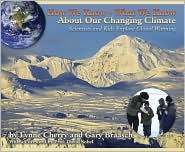
How We Know What We Know About Our Changing Climate: Scientists and Kids Explore Global Warming A Book about Climate Science and Solutions by Lynne Cherry and photojournalist Gary Braasch. NOW AVAILABLE IN PAPERBACK!
LYNNE'S MOVIES
Lynne realized that she had to do something to try and stop Global Climate Change. She decided to make movies to tell success stories of young people fighting global warming. Lynne hopes that these heartwarming, inspiring stories will encourage kids and adults alike to do what the kids in the movies are doing and personally commit to shrinking their carbon emissions.
The movies can be seen at YOUNGVOICESONCLIMATECHANGE.COM and everyone is encouraged to include a link to these films on their websites.
Eleven-year-old Felix Finkbeiner has planted 500,000 trees in Germany. Alec Loorz has collected over 40,000 kids' signatures on a Declaration of Independence from Fossil Fuel that he wrote. Team Marine got a ban on plastic bags in their town. And girl scouts gave out 5000 CFC's door to door. Lynne hopes that you will start to shrink your carbon footprint today. Click on the movie titles to find out how you can replicate these projects!
Written in Water- a book for Grown-ups
Book Reviews:
Robert Coontz, deputy news editor, SCIENCE magazine:
"This beautiful and informative book fills a major gap in environmental writing for children. It covers a wide range of research, defining technical terms gracefully and naturally as they arise. The overall tone--urgent without being shrill, hopeful without being complacent--strikes me as just right. I happily recommend it."
Bill McKibben:
" This is a necessary book. It treats kids with respect--they deserve to know what's going on. But they also deserve to know that there's much that can be done and much that is being done. In a word, it's empowering!"
The book can be ordered at a 10% discount online from the publisher at Dawnpub.com
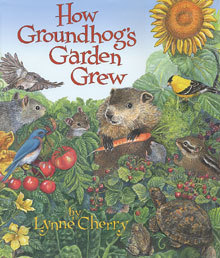
How Groundhog's Garden Grew
Published by Scholastic, 2003 ISBN 0-439-32371-1
Little Groundhog loves to eat his neighbor’s vegetables until he makes a friend who teaches him the joy of planting a garden of his own. As squirrel introduces Little Groundhog to the cycle of an entire gardening year, children will learn about gathering seeds in fall; storing them in winter; planting in spring; weeding and watering in summer; and a delicious, bountiful harvest at Thanksgiving time. An exuberant celebration of friendship, sharing, and the wonders of the natural world.
TO READ MORE ABOUT THIS BOOK, for teacher curriculum ideas, or to order a FREE teachers' guide, AND TO LEARN MORE ABOUT GREEN SCHOOLS, CLICK ON THE TITLE.
Reading level: Ages 4-8
Flute's Journey: The Life of a Wood Thrush written and illustrated by L.C.
Harcourt Brace, 1997 (ISBN 0-15-292853-7)
Living on Earth--Click to listen to Lynne Cherry read A River Ran Wild on NPR
The story of a wood thrush's arduous first migration--across thousands of miles—from his nesting grounds in the Belt Woods of Maryland to his winter home in Costa Rica, and back again. For a review of this book, click HERE!
TO READ MORE ABOUT THIS BOOK, for teacher curriculum ideas, to learn how you can help songbirds survive, and to hear how this book--and letters from children--helped save a 600 acre bird sanctuary, CLICK ON THE TITLE.
Reading level: Ages 6-11
The Sea, The Storm and the Mangrove Tangle
Published by Farrar, Strauss, Giroux, 2004
ISBN 0-374-36482-6
First a seed is jostled from a branch of a mangrove tree and floats far away to a lagoon in the Caribbean Sea. Then it takes root, sprouts leaves, and slowly begins to grow. Over many years, the mangrove will provide a home for numerous creatures of land and sea. In this richly illustrated chronicle of the life of one mangrove tree, Lynne Cherry details the abundant wildlife that depends upon its unique and wonderful ecosystem, one that is beneficial to so many, but one that also faces many dangers.

WRITTEN IN WATER: A Message for the Future edited by Irena Salina Published by National Geographic (not a children's book)
Making a Difference in the World: Lynne's Autobiography
Lynne’s mother, Helen Cogancherry, is also a children’s book illustrator. In this book we see her mother’s influence as she paints Lynne’s portrait and encourages her, as a child, to write and draw. We also see Lynne planting a tree with her father. In taking us through her life of writing and illustrating books that teach about rain forests, bird migration, saving the ancient forests and cleaning up streams and rivers—Lynne shows children that they, too, can make a difference in the world.
(to order call Richard Owen Publishers at 800-336-5588)
TO READ MORE ABOUT THIS BOOK, CLICK ON THE TITLE.
Reading level: Ages 5-10
The Shaman's Apprentice: A Tale of the Amazon Rain Forest
Harcourt Brace, 1998 (ISBN 0-15-201281-8) Ages 6-10
The Dragon and the Unicorn
Harcourt Brace, 1995 (ISBN 0-15-224193-0)
A stirring environmental story and a lavishly illustrated original fairy tale about preserving old-growth forests.
TO READ MORE ABOUT THIS BOOK, and for teacher curriculum ideas, CLICK ON THE TITLE.
Click here to see Folkmanis Dragon and Unicorn puppets
Reading level: Ages 6-11
The Armadillo from Amarillo
Harcourt Brace, 1994 (ISBN 0-15-200359-2)
Introduces Sasparillo, the armadillo, who sets off on an adventure to discover where in the world he is. This tale is an ecological jewel about Texas geography, history, and native fauna and flora.
TO READ MORE ABOUT THIS BOOK, and for teacher curriculum ideas, CLICK ON THE TITLE.
Reading level: Ages 5-9
The Art of Reading
ISBN 0-525-47484-6
Twenty artists including Lynne Cherry describe their favorite childhood book and how it inspired them to become a children's book author/illustator. 96 pages. full-color illustrations. Dutton 800-631-8571
http://www.rif.org/art/illustrators/cherry.mspx
The Big Book For the Planet
From Island to Island by Lynne Cherry
Now we are finally realizing about the limits to growth just like the little girl traveling from island to island, listening to her grandmother's tale--the history of their people.
Where Butterflies Grow
by Joanne Ryder/illustrated by L.C.
E.P. Dutton, 1989 ISBN 0-525-67284-2
Living on Earth--Click to listen to Lynne Cherry read this book on NPR
Scientifically accurate drawings show the metamorphosis of a Black Swallowtail butterfly from caterpillar to chrysalis to butterfly.
TO READ MORE ABOUT THIS BOOK, and for teacher curriculum ideas, CLICK ON THE TITLE.
Reading level: Ages 4-8
http://www.pollinator.org/ FOR INFO ABOUT WHAT YOU CAN DO TO HELP POLLINATORS
Chipmunk Song
by Joanne Ryder/illustrated by L.C., 1987
A child imagines shrinking down to the size of a chipmunk and seeing the world from that vantage point.
For a review by a child reader, go to this site: Reading Rainbow: Episode, The Salamander Room!
Reading level: Ages 4-8
The Snail’s Spell
by Joanne Ryder/illustrated by L.C. 1985; paperback1988 ISBN 0-14-050891-0 out of print but you can find copies on the internet
Published in 1988, this is the first book that Lynne Cherry illustrated in full color. A boy imagines that he has shrunk down to the size of a snail.
Reading level: Ages 3-7
When I'm Sleepy by Jane Howard, illustrated by Lynne Cherry
E.P. Dutton, 1985 ISBN 0-525-45561-2
A child imagines sleeping with various animals...in a swamp with turtles, on icebergs with pengins, in a nest with a baby bird. This is a wonderful way to introduce the concept of "habitat" to young children. .
Reading level: pre-K to grade 2
Cuando Tengo Sueno
When I'm Sleepy in Spanish
E.P. Dutton ISBN 0-525-45562-0
TO READ MORE ABOUT THIS BOOK, and for teacher curriculum ideas, CLICK ON THE TITLE.
"Cuando tengo sueno, a veces quisiera acurrucarme en una canasta, o dormirme ien un nido mullido.
Cuando tengo sueno y me estiro y bostezo, me pongo a pensar como seria dormir in un pantano."
Reading level: pre-K to grade 2
Who's Sick Today?
Harcourt, Brace, 1998 (ISBN 0-15-2018867 paperback)
Beavers with fevers, a gnu with the flu and a snake with an ache quiet children’s fears about visiting the doctor or going to the hospital. Who’s Sick Today also introduces simple rhyme to inspire children to write their own.
Reading level: pre-K to grade 2